Resistance you can specify
We quote the surface resistance range rather than a vague anti-static claim, so your ESD coordinator has a number to check against the standard.
Surface resistance 10⁶–10⁹ Ω
Carbon-infused knits and PU palms that bleed static without shedding lint — for PCB, electronics and clean assembly work.
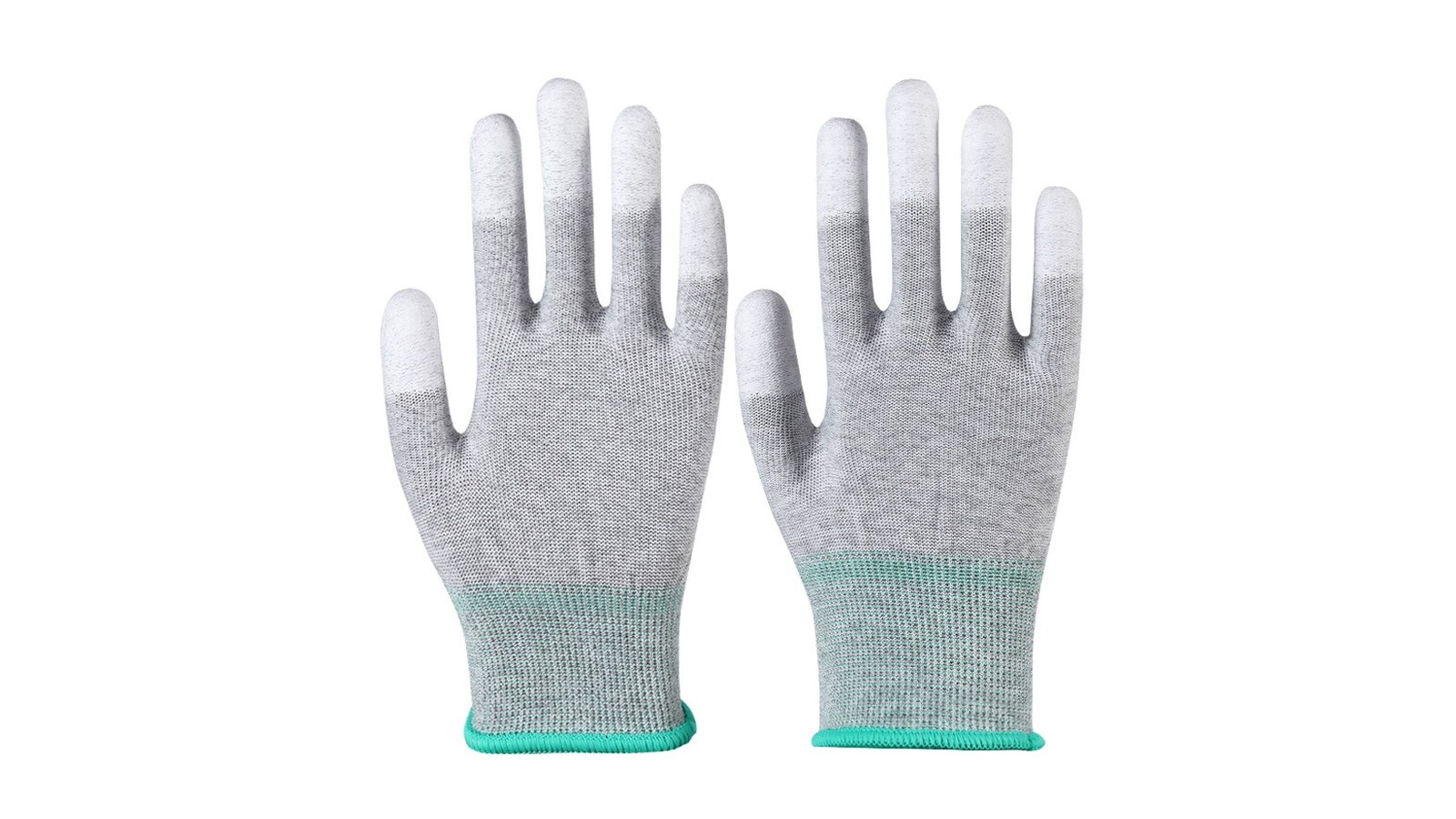
ESD gloves exist because static damage is invisible until a board fails. They work by giving charge a controlled path to dissipate instead of building on the hand or the part. That makes surface resistance the specification that matters, not the word "anti-static" on the packaging.
We build ESD gloves on carbon-infused nylon or polyester with a PU palm, targeting the 10⁶–10⁹ Ω range used in electronics assembly. Conductive fingertips are available for touchscreens, and the knit is designed to keep lint away from boards.
Anti-static and dissipative are not the same thing, and the difference matters when you write the spec. A glove that bleeds static away slowly is not the same as one that controls the rate at which charge moves, and only the second belongs on a bench where a single spike damages a board. Tell us the resistance range your process specifies and whether the glove is laundered and re-measured between shifts, because a coating that washes out after ten cycles is not a saving.
Reviewed · Specs confirmed on the approved sample
We quote the surface resistance range rather than a vague anti-static claim, so your ESD coordinator has a number to check against the standard.
Continuous-filament nylon and a PU palm shed far less fiber than cotton or staple yarns — important near exposed boards and optics.
Fine-gauge liners keep enough dexterity for SMT parts, connectors and cable work, which is where most handling time is spent.
Reference
Ratings depend on liner, gauge and coating. Final values are confirmed on the approved sample.
Gloves are one part of an ESD program. Wrist straps, flooring and packaging also determine whether a workstation is protected.
| Build | Resistance | Lint | Typical use |
|---|---|---|---|
| Carbon nylon, PU palm | 10⁶–10⁸ Ω | Low | PCB assembly, test |
| Carbon polyester, PU palm | 10⁷–10⁹ Ω | Low | General electronics |
| Carbon knit, no coating | 10⁶–10⁹ Ω | Medium | Packing, warehouse ESD zones |
| Carbon fiber, PU fingertips | 10⁶–10⁹ Ω | Low | Electronics, dust-free assembly, clean handling |
| Standard PU (not ESD) | Insulating | Low | Not suitable for ESD areas |
Questions buyers ask
If your question is about a specific style, send the spec and we will answer with the sample plan instead of a generic reply.
They are made with conductive carbon yarn to a specified resistance range. Confirm the range against your ESD program and check a sample with your own meter before adopting the style.
Conductive fingertips work with capacitive screens. Because the whole glove is mildly conductive, touch response is usually reliable.
Wash cool without fabric softener, which coats the fibers and raises resistance. Air-dry; do not tumble dry on high heat.
Anti-static usually means the material resists charge build-up. ESD means it dissipates charge in a controlled way within a defined resistance range. For electronics work, specify the range.
Next step
Share the glove type, liner and coating, quantities and destination. We reply with the sample plan, unit price at your quantity and the packaging options for your market.